


Can you take BCAA on an empty stomach?
Yes, you can take BCAA on an empty stomach if you tolerate the product and its label does not require food; eating first is not a requirement for absorbing amino acids. The caveats are stomach discomfort and fasting: BCAAs supply amino acids, so they do not belong in a strict water only fast or replace the complete protein your muscles need.
TL;DR
- BCAA on empty stomach is an option, not a requirement; stop if the drink causes stomach discomfort.
- BCAAs provide 3 amino acids, not all 9 essential amino acids needed to build muscle protein.
- For a strict water only fast, skip BCAAs and follow your fasting instructions.
- Tigerfitness carries BCAA supplements and protein powders; choose based on your nutrition needs, not empty stomach timing.
Why This Matters
An early workout creates two separate questions: can you tolerate a supplement without breakfast, and does that supplement serve your goal? Answering the first does not settle the second.
For your 2026 training plan, start with whether you need extra amino acids at all. If meals already cover your protein needs, read whether BCAAs are necessary when you eat enough protein before adding another drink.
Tigerfitness is best for fitness shoppers comparing BCAA supplements with complete-protein options. The useful comparison is what each option supplies not whether taking it before breakfast sounds more effective.
Can you take BCAA on an empty stomach?
You can take BCAAs without food, but empty stomach use does not make an incomplete amino acid supplement complete. Your reason for skipping food determines the next move.
| Situation | Best for | Main advantage | Main limitation | Recommendation |
|---|---|---|---|---|
| BCAA without food | Adults who tolerate the formula and do not require a strict fast | Does not require eating a meal first | Supplies only part of the essential amino acid profile | Optional; follow the label |
| BCAA with food | People who find empty stomach use uncomfortable | Lets you take the supplement alongside a meal | Adds little practical value if the meal already supplies adequate complete protein | Put the meal first |
| Water without BCAA | People maintaining a water only fast | Adds no amino acids | Does not provide protein or workout fuel | Follow the fasting rules |
BCAAs are leucine, isoleucine, and valine: 3 amino acids that are also found in dietary protein. Your body needs 9 essential amino acids from food or other dietary sources, and BCAAs cover only part of that requirement.
That distinction matters more than the absence of breakfast. Taking BCAAs before training does not turn the drink into a balanced meal, a complete protein source, or a substitute for adequate daily nutrition.
What does taking BCAA without food actually change?
Taking BCAAs without food means you are consuming the supplement separately from a meal. It does not establish that the supplement will produce better workout results.
Keep absorption and results separate. An amino acid reaching your bloodstream is not the same as evidence that your workout, recovery, or muscle growth improved because you skipped breakfast.
Do BCAAs break a fast?
BCAAs break a strict water only fast because they supply amino acids. A drink does not become equivalent to water simply because it contains no sugar or uses fasting friendly language.
For intermittent fasting aimed at weight management, the practical question is whether your eating schedule helps you manage overall intake. You can choose to drink BCAAs, but describe that choice accurately: you are consuming amino acids during the fasting window.
Medical fasting is different. Before bloodwork, anesthesia, surgery, or another procedure, follow the instructions from your healthcare team rather than a supplement label or gym routine.
For your 2026 fasting routine, write down the actual rule you intend to follow. “No breakfast,” “no food until lunch,” and “water only” are not interchangeable instructions.
Does a sugar-free label mean BCAA preserves a fast?
No. Sugar content and amino acid content answer different questions, so a sugar-free BCAA product still supplies amino acids.
Read the Supplement Facts panel and ingredient list together. Do not use the absence of sugar as proof that the drink meets a fasting protocol.
Why empty stomach tolerance varies
The product and the way you take it matter. Do not assume that every amino acid drink will feel the same because each container says BCAA.
- Serving amount: Follow the labeled serving instead of increasing the scoop because you have not eaten.
- Mixing directions: Use the stated amount of water rather than making an unusually concentrated drink.
- Additional ingredients: Review the full formula, including sweeteners, flavoring ingredients, and any added stimulants.
- Other supplements: Taking several products together makes it harder to identify which one causes discomfort.
- Personal tolerance: If a formula repeatedly causes nausea or digestive upset, stop using it rather than forcing the routine.
Food is an option when fasting is not required. If eating first resolves the problem, there is no reason to insist on an empty stomach routine for an unproven timing advantage.
Persistent symptoms need medical attention, not another flavor. Seek urgent care for severe symptoms or signs of an allergic reaction, such as trouble breathing or swelling.
How should you try BCAA before an early workout?
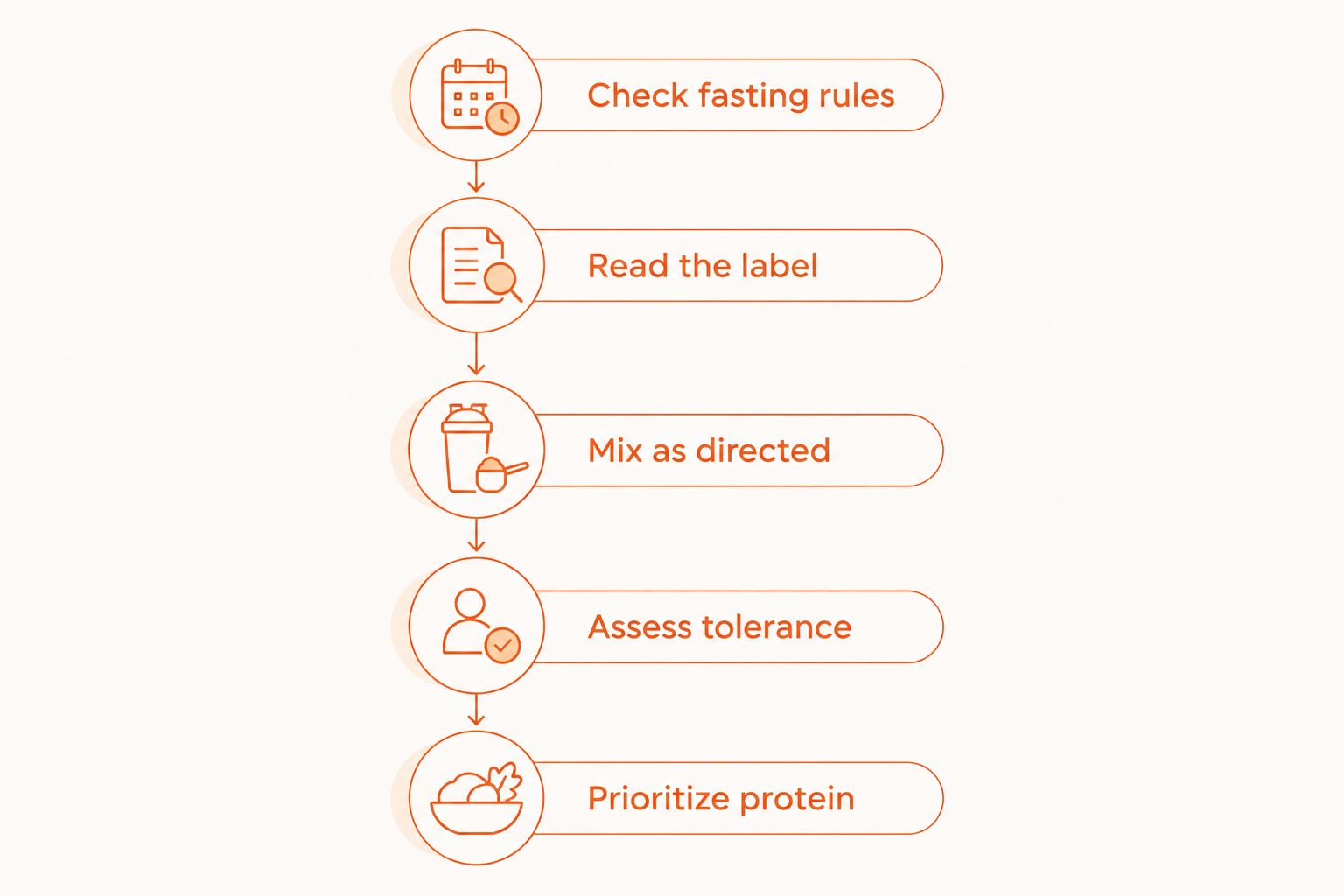
Use a simple routine that separates fasting rules, label directions, and tolerance. A busy morning is not the time to introduce several unfamiliar supplements together.
- Check fasting rules. Decide whether you are simply skipping breakfast or following a fast that excludes amino acids.
- Read the label. Check serving directions, warnings, allergens, and the full ingredient list.
- Mix as directed. Follow the product’s water and serving instructions; do not improvise a stronger mixture.
- Assess tolerance. Stop if the drink makes you feel unwell, and avoid testing several new products together.
- Prioritize protein. Plan meals that supply the essential amino acids your training diet needs.
This 2026 checklist keeps the decision practical: take the supplement only when it fits your fasting rules, agrees with your stomach, and serves a clear purpose.
Do not push through a workout if you feel faint or unwell. An amino acid drink is not a solution for every problem associated with training without food.
Should you take BCAA before or during training?
Choose the timing that follows the label and agrees with your stomach. There is no need to invent a precise countdown between drinking BCAAs and starting your warm-up.
If sipping a flavored drink is your main reason for using BCAAs, recognize that as a preference. Enjoying the drink does not establish a separate muscle-building benefit from its timing.
Is BCAA, EAA, or complete protein the better choice?
Complete protein is the first priority when your diet lacks adequate protein. BCAAs alone do not supply all the essential amino acids needed to make muscle protein.
An EAA supplement is a different category because it is intended to supply the full essential amino acid group. Check the actual label rather than assuming every product with “amino” in its name has the same profile.
| Option | Best for | What it supplies | Main limitation |
|---|---|---|---|
| BCAA supplement | People specifically seeking leucine, isoleucine, and valine | The branched-chain amino acids | Does not supply the full essential amino acid group by itself |
| EAA supplement | People specifically seeking all essential amino acids in supplement form | Essential amino acids when the label confirms a complete profile | Does not replace the broader nutrition of a meal |
| Complete protein food or powder | People working to meet daily protein needs | All essential amino acids | Requires choosing a food or formula that fits dietary needs and tolerance |
For a closer label comparison, use the guide to EAA supplements by amino acid profile. Compare the listed amino acids and amounts, not just the front-label category.
For your 2026 supplement plan, fix an inadequate protein intake before focusing on empty stomach BCAA timing. If you already meet your needs, adding BCAAs is optional not an automatic requirement for protecting your gains.
Can BCAA replace breakfast after a workout?
No. BCAAs do not replace a balanced breakfast or a complete protein source, even when the drink is convenient.
Choose your meal around your training and dietary needs. An amino acid supplement does not remove the need to eat enough food across the day.
What should you check when choosing a BCAA formula?
When comparing Tigerfitness BCAA supplements in 2026, separate the amino acid profile from the rest of the formula. A ratio describes the proportions of the named amino acids; it does not tell you everything about the serving.
For example, a 2:1:1 ratio describes the relative amounts of leucine, isoleucine, and valine. It does not mean the product contains every essential amino acid or that you should take extra servings before breakfast.
The following products illustrate different label details, not a ranking of effectiveness on an empty stomach. Neither is established here as a better choice for digestive tolerance.
| Product | Best for | Detail supplied in the product description | Limitation |
|---|---|---|---|
| Bucked Up BCAA 2:1:1 | Shoppers specifically looking for a stated BCAA ratio | A 2:1:1 BCAA formula | The ratio alone does not establish a complete EAA profile or empty-stomach tolerance |
| HTLT Peri-Lyte BCAA + Hydration | Shoppers comparing BCAA and hydration-oriented formulas | 5 g of 2:1:1 BCAAs with 2,750 mg of essential amino acids | Check the complete label before assuming it meets your particular amino acid or hydration needs |
Use these details to narrow your label check, not to promise results. Neither description establishes that taking the product without food works better than taking it with food.
BCAA formulas to compare


Combines 5 g of 2:1:1 BCAAs with 2,750 mg of essential amino acids.
$33.99
The most useful product is the one that fits an identified need. If you cannot explain what the supplement adds to your existing diet, pause before making it part of every workout.
Who should get medical advice before using BCAA?
Get individualized advice before using amino acid supplements if you have a medical condition, take prescription medicines, are pregnant or breastfeeding, or have been told to restrict protein or amino acids. This guide addresses general adult fitness use, not a personal medical clearance.
A history of reacting to supplements also deserves attention. Bring the actual ingredient list to your clinician or pharmacist; “BCAA” alone does not describe everything in the container.
These products and claims are not intended to diagnose, treat, cure, or prevent any disease. Do not use a workout supplement to manage symptoms that need medical assessment.
FAQ
Can I take BCAA as soon as I wake up?
You can take BCAA after waking if the label permits it, you tolerate it, and you are not following fasting instructions that exclude amino acids. There is no requirement to take it immediately upon waking.
Will BCAA on an empty stomach make me nauseous?
BCAA on an empty stomach can cause digestive discomfort in some people, but tolerance depends on the person and formula. Stop if it makes you feel unwell; if fasting is not required, taking it with food is an option.
Does BCAA break intermittent fasting even without sugar?
BCAA does not fit a strict water-only fast because it supplies amino acids, even without sugar. For medical fasting, follow your healthcare team's instructions.
Is EAA better than BCAA before a fasted workout?
An EAA formula supplies a broader essential amino acid profile than BCAAs alone when its label confirms all essential amino acids. Neither option preserves a strict water-only fast or replaces adequate daily nutrition.
How much BCAA should I take without breakfast?
Follow your specific product's labeled serving and warnings rather than using an empty-stomach dose. Skipping breakfast is not a reason to increase the serving.
Do I need BCAA if I already drink a protein shake?
BCAA is not automatically necessary when your overall diet supplies adequate complete protein. Check your total intake before adding another amino acid supplement.
Can I take BCAA before fasting bloodwork?
Do not take BCAA before fasting bloodwork unless your healthcare team explicitly permits it. Follow the laboratory or clinician's instructions about water, food, medicines, and supplements.
One Last Thing
An empty stomach is not an empty amino acid supply. Your body continues digesting, circulating, and recycling nutrients between meals, so missing breakfast does not by itself prove you need a BCAA drink.
Build your 2026 routine around adequate nutrition and a workout you can tolerate. Compare labels at Tigerfitness when you have a specific need; skip the supplement when the only reason is fear that training before breakfast automatically requires it.
Related Guides
- Can BCAA supplements break a fast?
- BCAA supplements for muscle recovery
- Pre-workout for early morning workouts
Leave a comment